


Ancestral Collage: Sojourner Truth; Harriet Tubman; Cicely Tyson
- The H3O/Art of Life Blog

- Apr 7
- 6 min read
By AbdudDharr Abdullah
Presented by Omni-U Virtual University
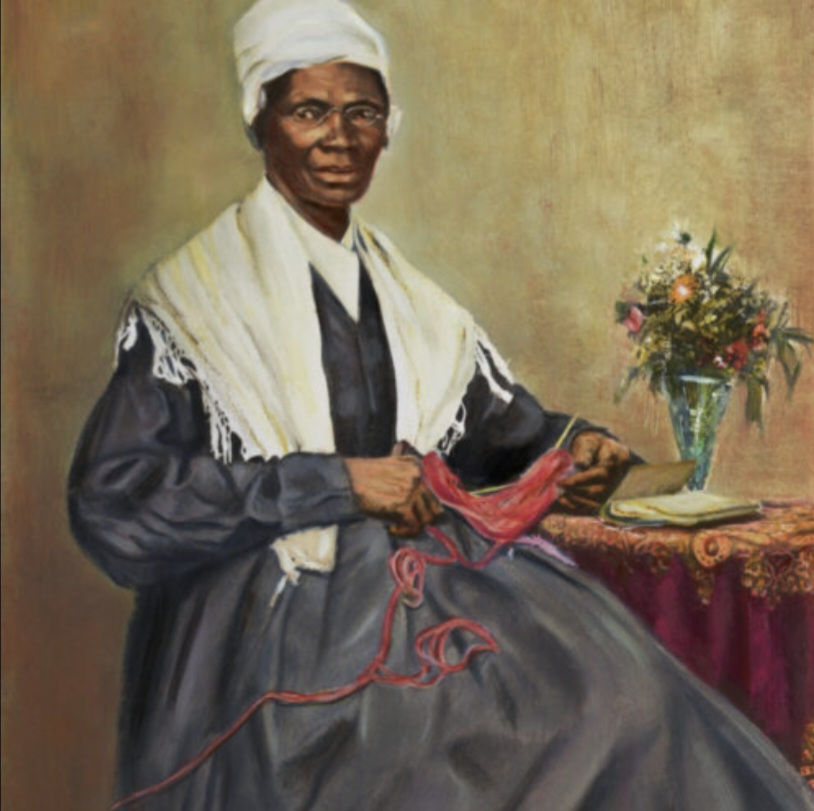
"Children, I talks to God and God talks to me. I goes out and talks to God in de fields and in de woods. This morning, I was walking out and I got over de fence. I saw the wheat hold up its head looking very bare and looking very dead. I goes up and takes ahold of it. Can you believe it? There wasn't any wheat 'dere!
Din I says, "God, What ails dis wheat?" And he says to me, "Sojourner, There's a little weevil* in it." Now, I heard talk about dis Constitution and the rights of man. I comes up and takes a hold of this Constitution. It looks mighty big. And I feels for my rights but, there ain't any dere. Then I says, "God! What ails dis Constitution?" He says to me, "Sojourner, There's a little weevil* in it." Ancestor Sojourner Truth (1797-1883)
Sojourner Truth, born circa 1797, was a prominent abolitionist and women’s rights activist. She was born into slavery in Swartekill, Ulster County, New York. Her name was Isabella and she served a household in New Paltz, New York, from 1810 to 1827, where she bore some five children by a fellow slave. At least two of her daughters and one son were sold away from her during these years. After escaping slavery with her infant daughter to freedom in 1826, she embraced evangelical religion and became involved in moral reform and abolitionist work. When she went to court to recover her son in 1828, she became the first black woman to win such a case against a white man.
Truth was six feet tall, blessed with a powerful voice and driven by deep religious conviction. Harriet Beecher Stowe attested to Truth’s personal magnetism, saying that she had never “been conversant with anyone who had more of that silent and subtle power which we call personal presence than this woman.”
She lent her unique skills to the women’s suffrage movement and initiated a petition drive to obtain land for the freedpeople, even suggesting the idea of a “Negro state” in the West. In May of 1851, she attended the Ohio Women's Rights Convention in Akron, Ohio, where she delivered her famous extemporaneous speech on women's rights, later known as “Ain’t I A Woman?”. Her speech demanded equal human rights for all women as well as for all blacks. She preached cleanliness and godliness among the freedpeople and dictated many letters about the land question.
During the Civil War, Truth helped recruit black troops for the Union Army; after the war, she tried unsuccessfully to secure land grants from the federal government for former slaves. In 1865, while working at the Freedman’s Hospital in Washington, Truth rode in the streetcars to help force their desegregation. In 1870, Truth tried to secure land grants from the federal government to former enslaved people, a project she pursued for seven years without success.
She died at her Battle Creek home on November 26, 1883. In 2014, She was included in Smithsonian magazine's list of the "100 Most Significant Americans of All Time"
Sojouner Truth: In her own words…
Truth is powerful and it prevails.
I am not going to die, I'm going home like a shooting star.
If women want any rights more than they's got, why don't they just take them, and not be talking about it.
[*] Weevil- A weevil is a beetle. The "boll weevil" is a weevil that feeds on cotton buds and flowers...[by] the late 19th century, it had infested all U.S. cotton-growing areas...devastating the industry... in the American south.
https://www.history.com/topics/black-history/sojourner-truth https://en.wikipedia.org/wiki/Sojourner_Truth
Harriet Tubman ,born Araminta Harriet Ross,
was an African-American abolitionist, humanitarian, and Union spy during the American Civil War. Born into slavery in 1849, she fled, leaving her husband and family behind in order to escape. Despite a bounty on her head, she returned to the South to lead her family and hundreds of other slaves to freedom. She subsequently made more than 19 missions to rescue more than 300 slaves with the help of the network of antislavery activists and safe houses known as the Underground Railroad. Utilizing her native intelligence and drawing on her boundless courage, she eluded bounty hunters seeking a reward for her capture, which eventually went as high as forty thousand dollars. She never lost a fugitive or allowed one to turn back.
Two things sustained her: the pistol at her side and her faith in God. She would not hesitate to use the pistol in self-defense, but it was also a symbol to instruct slaves, making it clear that “dead Negroes tell no tales.” Timid slaves seemed to find courage in her presence; no one ever betrayed her.
Tubman also served as a scout, spy and nurse during the Civil War. She later helped recruit men and collaborated with John Brown for his raid on Harpers Ferry that took place on October 16-18, 1859, to free enslaved Blacks. The two met in Canada where she told him all she knew of the Underground Railroad in the East. Advising him on the area in which he planned to operate, she promised to deliver aid from fugitives in the region. Brown’s admiration for her was immeasurable, and he wanted her to accompany him on the raid. Tubman planned to be present but was ill at the time and could not participate. In June 1863, Tubman became the first woman to lead an armed expedition in the Civil War. She guided the Combahee River Raid, which liberated more than 700 enslaved Blacks in South Carolina: the largest liberation of enslaved Black people in American history.
The early years of the Women’s Rights Movement date back to 1848 when for the first time small groups of women who had been working individually joined together in the National Women’s rights Convention in Seneca Falls, New York. There they laid out a list of rights that women did not enjoy at the time such as the right to attend college, own property or enter male dominated professions such as medicine and law. The most controversial issue considered in the convention was women’s suffrage. Tubman believed in the equality of all people, black or white, male or female, which made her sympathetic to the women’s rights movement. She travelled giving speeches on women’s rights. Her most memorable appearance was at the organizing meeting of the National Association of Colored Women in 1896 in Washington, D.C. Two generations came together to celebrate the strength of black women and to continue their struggle for a life of dignity and respect. Harriet Tubman, the oldest member present, was the embodiment of their strength and their struggle.
She became a philanthropist who provided to those who sought her help. She left the door of her residence, at South Street, open for those who needed shelter and food. For years freed slaves came and left when they were ready to move on. She took care of all their needs even though she was penniless. She supported herself and those she sheltered by selling produce from her garden, taking in donations of food and asking friends for loans.
Harriet Tubman died of pneumonia on March 10, 1913. Before her death she told friends and family surrounding her death bed: “I go to prepare a place for you.”
http://atlantablackstar.com/2013/10/29/10-fearless-black-female-warriors-throughout-history/ http://www.harriet-tubman.org/women-rights-suffrage/
Cicely Tyson
”Cicely L. Tyson is an American actress and former fashion model. In a career spanning more than seven decades, she became known for her portrayal of strong African-American women.
She was born in Harlem on December 19, 1924, the daughter of Frederica Tyson, a domestic worker, and William Augustine Tyson, who worked as a carpenter, as a painter and at any other jobs he could find. Her parents were immigrants from Nevis in the West Indies. She was discovered by a photographer for Ebony magazine and became a popular fashion model and worked as a secretary and model while establishing herself as an actress.
She has been married only once; to Miles Davis. She is co-founder of the Dance Theatre of Harlem along with Arthur Mitchell.
Her image appeared on the cover of Time magazine this year where she was highlighted as one of 34 people whom the magazine dubbed as ‘THE OPTIMISTS – 34 people changing how we see our world’.
Her caption reads: “I am the sum total of each one of the women I have played. That they were able to survive the times, and the way in which they did it, made me a stronger person and allowed me to truly believe that all things are possible.”
Tyson's memoir, Just As I Am, was published on January 26, 2021, and she promoted the book during the last weeks of her life. When she was asked how she wanted to be remembered in an interview with Gayle King, Tyson said, "I’ve done my best. That’s all."
Tyson died on January 28, 2021, at the age of 96.
The New Abolitionists (Neo) Slave Narratives and Contemporary Prison Writings By: Joy James


Comments